nabu-lects
A small, curated registry of lects — language varieties identified by genealogical anchor × historical stage × variety × orthography — with a universal mapping from the standard language codes (ISO 639, Wiktionary) onto them.
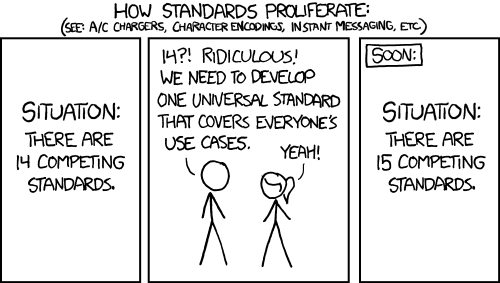
xkcd #927, “Standards” by Randall Munroe, CC BY-NC 2.5.
Yes — we know. So this registry is deliberately not the fifteenth standard: it mints no new language codes. Every identifier is anchored in a code you already use, and the registry’s whole job is to write down how the fourteen existing standards line up — and precisely where each one stops.
The problem, in four codes
latcovers Plautus, Cicero, the Vulgate, and twelfth-century monastic charters alike — there is no ISO code for Old, Late, Medieval, or Neo-Latin.grc(“Ancient Greek, to 1453”) spans Homer to the fall of Constantinople — a cataloguing convention, not a linguistic boundary.lzhcodes Literary Chinese, a written register used across two millennia, as if it were a historical stage.la-vulnames both attested Vulgar Latin (the Appendix Probi) and the reconstructed Proto-Romance of the comparative method — evidence and inference fused in one code.
The full argument — with a review of every prior system, from ISO 639-6’s rise and withdrawal to Glottolog, BCP 47, and Wiktionary — is in Prior art and the case for lects.
The answer, in one line
lect-id = anchor [ ":" stage ] [ "/" variety ] [ "~" script ] [ "@" ortho ]
| Example | Meaning |
|---|---|
lat |
Latin, the whole span — honest coarseness |
lat:med |
Medieval Latin |
lat:late/ecc |
Late Latin, ecclesiastical register |
grc:koi |
Koine Greek |
zho/lit |
Literary Chinese (wenyan) — a register, not a stage |
roa:pro |
Proto-Romance — mode: reconstructed in the registry |
jpn:mod@kyu |
Modern Japanese in pre-reform (kyūjitai) orthography |
san~latn |
Sanskrit held as a romanized edition |
Anchors are ISO 639 / Wiktionary codes, so every identifier stays legible
to anyone who knows the standard codes. Stages carry date bands with their
provenance recorded; genealogy is explicit parent: edges (roa: {parent:
lat} — no pseudo-family nodes); reconstruction is a data field, never a
naming convention; the ~ axis claims the script of the text as held
(ISO 15924, lowercased, from a global table), never the artifact’s
original writing system. Field-by-field semantics: the schema.
Integrating the registry in your tool
The registry is two plain YAML files, consumable with any parser:
https://raw.githubusercontent.com/arvicco/nabu-lects/main/lects.yml
https://raw.githubusercontent.com/arvicco/nabu-lects/main/codemap.yml
The identity default. codemap.yml lists only non-identity mappings.
Any code not listed maps to itself as a bare anchor — so your tool needs no
registry entry for a code to keep working, and adopting the registry cannot
break codes it doesn’t mention.
Precedence. Layer your own knowledge above the universal defaults:
per-document override > per-collection override > codemap.yml > identity
The registry states what is true of a code for anyone; what is true of
your holdings (this corpus’s lat is lat:med; that dictionary’s
la-vul is roa:pro) belongs in your own override layer, keyed however
your tool keys collections.
The one machine-load-bearing field. A stage with mode: reconstructed
marks a comparative-method reconstruction. Key asterisk display,
etymological-closure rules, or evidence filters on that field — never on
the spelling of a tag or the suffix of a code.
Validating a vendored copy. If you vendor the files, run the bundled validator (plain Ruby, standard library only) against them:
bin/validate
It checks the identifier grammar, referential integrity (every mapping
target and parent edge resolves), ord uniqueness, band sanity, Glottocode
shape, and parent-graph acyclicity — the same script CI runs here.
Stability: pre-1.0 instability window — identifiers may be renamed or restructured without notice until the first tagged release. After v1.0.0, semantic versioning applies to the identifier space itself; see the README.
Attribution. CC BY 4.0: use freely, credit “nabu-lects” with a link to this repository.
The family
This registry was born from the holdings of Nabu — a personal research library of ancient-text corpora, roughly a million documents across more than 120 language codes — and is the frame that library describes its holdings with. Sister projects: nabu-data, the datasets the library publishes, and the School, the scribal-school reading environment built on top.
Contributions and corrections: issues and pull requests on
github.com/arvicco/nabu-lects —
every change passes bin/validate, and band or genealogy corrections are
welcome with a source note.